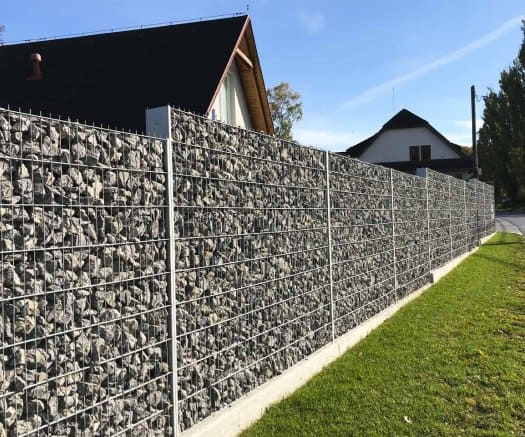
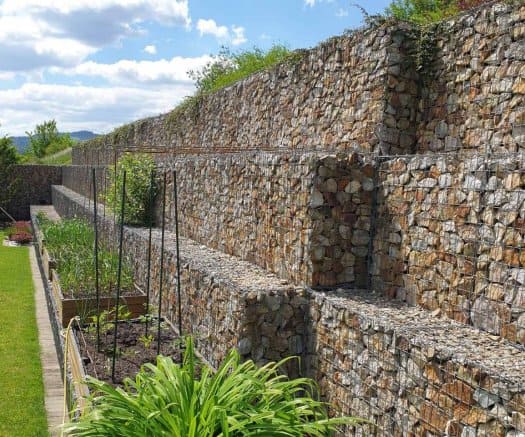
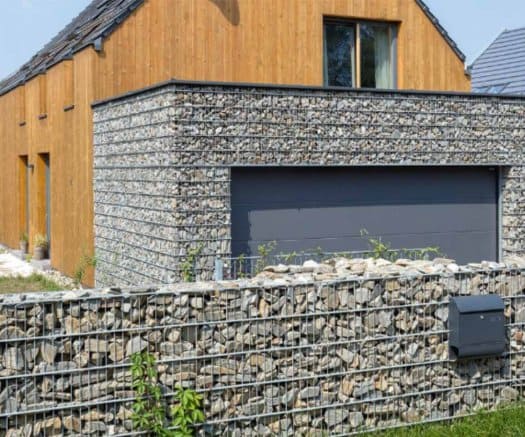
A gabion wall is beautiful and durable, but its longevity depends on proper drainage. Water is its biggest enemy: it carries fine particles, builds pressure in the backfill, and freezes in winter. The result can be stained stone, deformation, and faster corrosion of the baskets. This article focuses on gabion supporting walls and explains how to choose the right geotextile, how to layer the base, where to run pipes, and what slopes to maintain so you end up with a long‑lasting, dry, and clean gabion.

Proper drainage protects a gabion from water build‑up and clogging. Without filtration, fine soil particles migrate into the bed behind the basket, clog the drain, and then wash dirt through the stone face. In winter, water in the backfill can freeze, expand, and push baskets outward or create bulges. Prolonged damp contact accelerates wire corrosion, especially where the coating has been damaged. Good drainage is therefore an investment in appearance, stability, and service life.
A geotextile may be unobtrusive, but it’s decisive. It serves two functions: separation (keeping soil out of the drainage aggregate) and filtration (letting water through while retaining fines).
The right layer build‑up provides bearing capacity and drains water. The goal is to intercept water from the terrain into the drainage zone and carry it away safely.
Both the sub‑base and the drainage system must have a clear outflow direction. Never leave a drain pipe without a functioning outlet.
Water behaves more aggressively on slopes. The essentials are stepping the footing and creating terraces.
→ Detailed installation instructions for gabion fences!
Twice a year, visually inspect outlets and access points; remove leaves and debris.

08:00 – 16:00

08:00 – 16:00

08:00 – 16:00

© 2026 GabionyLemon.com | The placement of content on other sites, its dissemination by the press and other media is subject to copyright and isonly possible with the written consent of LEMON trade s.r.o.
created

Secure Payment

A gabion wall is beautiful and durable, but its longevity depends on proper drainage. Water is its biggest enemy: it carries fine particles, builds pressure in the backfill, and freezes in winter. The result can be stained stone, deformation, and faster corrosion of the baskets. This article focuses on gabion supporting walls and explains how to choose the right geotextile, how to layer the base, where to run pipes, and what slopes to maintain so you end up with a long‑lasting, dry, and clean gabion.
Proper drainage protects a gabion from water build‑up and clogging. Without filtration, fine soil particles migrate into the bed behind the basket, clog the drain, and then wash dirt through the stone face. In winter, water in the backfill can freeze, expand, and push baskets outward or create bulges. Prolonged damp contact accelerates wire corrosion, especially where the coating has been damaged. Good drainage is therefore an investment in appearance, stability, and service life.
A geotextile may be unobtrusive, but it’s decisive. It serves two functions: separation (keeping soil out of the drainage aggregate) and filtration (letting water through while retaining fines).
The right layer build‑up provides bearing capacity and drains water. The goal is to intercept water from the terrain into the drainage zone and carry it away safely.
Both the sub‑base and the drainage system must have a clear outflow direction. Never leave a drain pipe without a functioning outlet.
Water behaves more aggressively on slopes. The essentials are stepping the footing and creating terraces.
→ Detailed installation instructions for gabion fences!
Twice a year, visually inspect outlets and access points; remove leaves and debris.
08:00 – 16:00
08:00 – 16:00
08:00 – 16:00